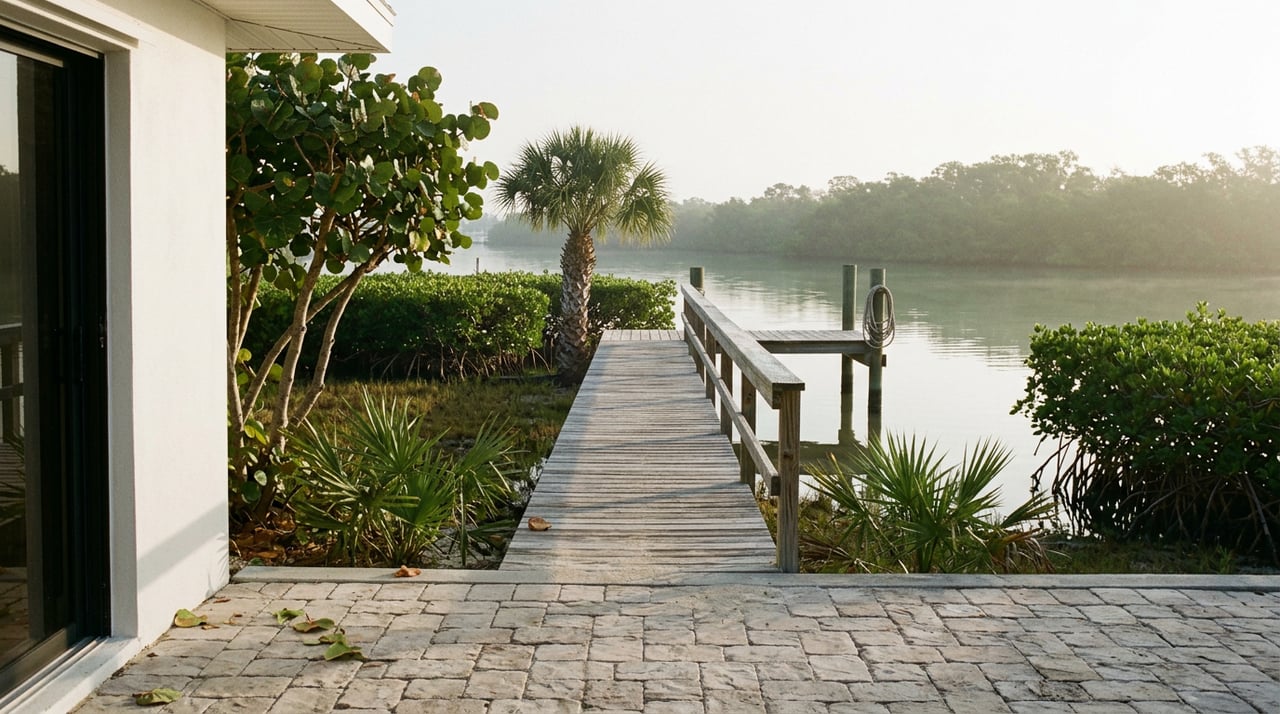
Walk the boardwalk at Indian Riverside Park on any given afternoon and you'll pass a mix that doesn't quite add up if you think of it as a normal town park. A retiree in a wide-brim hat is prepping a sailboat near the north end. A few kids are soaked from the splash fountain closer to the entrance. A dog walker is looping the mangrove path. Somewhere behind the trees, a wedding is setting up in a building that looks a century older than everything around it. Most people who live here have made peace with the fact that this park does a lot of things at once. Fewer stop to ask why.
The answer is that Indian Riverside Park was never designed as a park. It was designed as a marine-science campus, and the seams still show if you know where to look.
A Park Built From a Marine-Science Campus
Before Martin County owned this stretch of the Indian River Lagoon, it belonged to the Florida Institute of Technology, which ran its Jensen Beach campus here and taught oceanographic technology on the property. The campus closed in 1986. The county acquired the land afterward and built the public park that exists today, according to Treasure Coast's own history of the site.
That single fact explains a lot about why the 63-acre park has the specific shape it does. A generic waterfront park doesn't usually come with a four-lane boat ramp built for real vessel traffic, a dedicated sailing center offering lessons every day, and a mangrove boardwalk kept largely intact rather than paved over. A marine-science campus does. The county didn't design those features from scratch. It kept the ones a research institution already needed and layered family amenities on top.
Here's roughly how the pieces map:
| What you see today | Where it came from |
|---|---|
| U.S. Sailing Center, daily lessons | Marine and nautical training under the old FIT program |
| Four-lane concrete boat ramp | Built for research vessel access, still functional for public launches |
| Mangrove boardwalk and ¾-mile walking path | Preserved lagoon edge, once used for field study |
| Splash fountain and beach area | Added later, purely recreational |
| Treasure Coast Children's Museum | Housed in a repurposed structure on the same grounds |
The Martin County parks page confirms the park still functions this way today, with the sailing center, the boat ramp, and the museum all listed as active features on the same 63 acres. Most residents experience these as separate stops on separate days. They're actually one property that never fully stopped being what it was built to be.
The Mansion and the Actress Who Explains the Dockside Pavilion
The other structure that doesn't fit a typical park is the Mansion at Tuckahoe, built in 1936, long before FIT or the county ever touched the land. FIT used the mansion during its campus years, and Martin County has since turned it into an event venue, one of the more historically significant sites in the state according to the county's own description.
Next to it sits the Frances Langford Dockside Pavilion, a roughly 3,800-square-foot banquet hall with a wraparound balcony and room for up to 250 guests. The name isn't decorative. Frances Langford was a singer, entertainer, and film actress who lived in Jensen Beach, and part of her former home extends over the edge of the lagoon as a café today. The pavilion sits where her property once did.
So the two event venues that anchor the park's calendar of weddings and private gatherings aren't new construction either. One is a 1930s mansion that predates the park by decades. The other is built into the footprint of a local celebrity's former estate. If you've ever driven past a wedding party at the park and wondered why the buildings look older and more storied than a typical parks-department rental hall, that's why.
Two Blocks Away, the Same Instinct Runs the Calendar
Walk out of the park and into downtown Jensen Beach and the pattern holds. Every Thursday night, year-round, Jammin' Jensen turns Jensen Beach Boulevard into a free street festival with local artists, live music, and vendors. It's been running long enough that most residents treat it as background noise rather than an event, which is its own kind of proof that it works.
What's easy to miss is what happens around it. The same downtown blocks that hold the restaurants also hold a working cluster of art studios and galleries, and several of them extend their hours specifically on Thursday nights to catch the Jammin' Jensen foot traffic. The town didn't build a new arts district to create that overlap. It let an existing gallery block and an existing street festival occupy the same evening and grow into each other.
That's the same instinct at work in the park. Nobody built a new civic plaza for Jensen Beach's social life. They pointed an existing weekly tradition at an existing commercial block and let the two reinforce each other.
When the Big Festival Left, the Town Didn't Replace It
The clearest test of this pattern is what happened after Jensen Beach lost its biggest annual event. The Pineapple Festival ran for roughly 30 years and was, by most local accounts, one of the last true street festivals left in South Florida, complete with a Bahamian Market and national touring acts. It hasn't been held since 2019.
Most towns that lose a signature festival either scramble to build something equally large to replace it or let the calendar go quiet. Jensen Beach did neither. Jammin' Jensen kept running exactly as it had before, absorbing more of the town's weekly social weight simply by continuing to show up. And the piece of the old festival's identity that people missed most, its pineapple heritage, came back in a much smaller form: the Jensen Beach "Everything Pineapple" Tasting Tour, which held its second annual event on June 27, 2026, at the same downtown address Jammin' Jensen calls home. A second year isn't a guarantee for a new food event on the Treasure Coast, but it's a real signal that this one has found its footing rather than fading after a single try.
The same logic showed up again on Hutchinson Island this year. RockHouse Live, a music venue locals had watched sit dormant, reopened in January 2026 after a renovation that reportedly cleared out nine tons of debris and ran close to a million dollars. A shuttle bus connects it back to downtown.
None of these are coincidences stacked on top of each other. They're the same civic habit showing up in three different places: a park, a festival calendar, and a music venue. Jensen Beach tends to keep what it already has and find a new use for it rather than starting over.
What This Actually Means If You Live Here
If you've spent time at Indian Riverside Park without knowing its history, none of this changes how the splash fountain works or when the sailing center offers lessons. What it changes is how the place reads. The park isn't an assortment of unrelated amenities the county happened to cram onto one property. It's a former research campus that kept its bones and grew a public life around them. The mansion isn't a stock event hall. It's a building with an actual history that predates the park by fifty years. The Thursday night crowd downtown isn't a manufactured tourist draw. It's a decades-old habit that a gallery block quietly built its own schedule around.
Understanding that doesn't require a real estate transaction. It just means the next time you're walking the boardwalk or catching Jammin' Jensen on a Thursday, you're looking at a town that has spent close to four decades choosing to rebuild rather than replace.
If you're the kind of person who notices details like these and wants to talk about what living in a specific pocket of Jensen Beach actually looks like day to day, Tyler Cameron knows this stretch of the Treasure Coast from the ground up. Schedule a Consultation with Tyler whenever you're ready to talk through it.